
You turn the kitchen faucet expecting the usual rush, but instead get a pathetic trickle. Your morning shower feels like standing under a leaky garden hose. The bathroom sink takes three minutes to fill a glass. You start wondering if something’s broken in the municipal supply, or worse—whether you’re facing a massive plumbing bill.
Here’s what catches most homeowners off guard: that weak stream probably has nothing to do with your city’s water pressure. The real culprit is often a two-dollar component you’ve never thought about, quietly choking your flow while you blame the wrong system entirely.
The distinction between pressure and flow gets confused constantly, and that misunderstanding sends people down the wrong diagnostic path. Understanding which problem you actually have determines whether you’re looking at a five-minute fix or a call to professionals. Let’s cut through the guesswork and figure out exactly what’s happening in your plumbing.
Your 60-second action plan before you panic:
- Check your faucet aerator first—this solves the majority of weak-flow complaints in under five minutes
- Test multiple taps throughout your home to identify whether the issue is isolated or system-wide
- Measure your household pressure if all fixtures are affected (a basic gauge costs around fifteen dollars)
- Contact a licensed plumber if pressure reads below 40 PSI or if you have older galvanized pipes
The silent culprit hiding inside your faucet
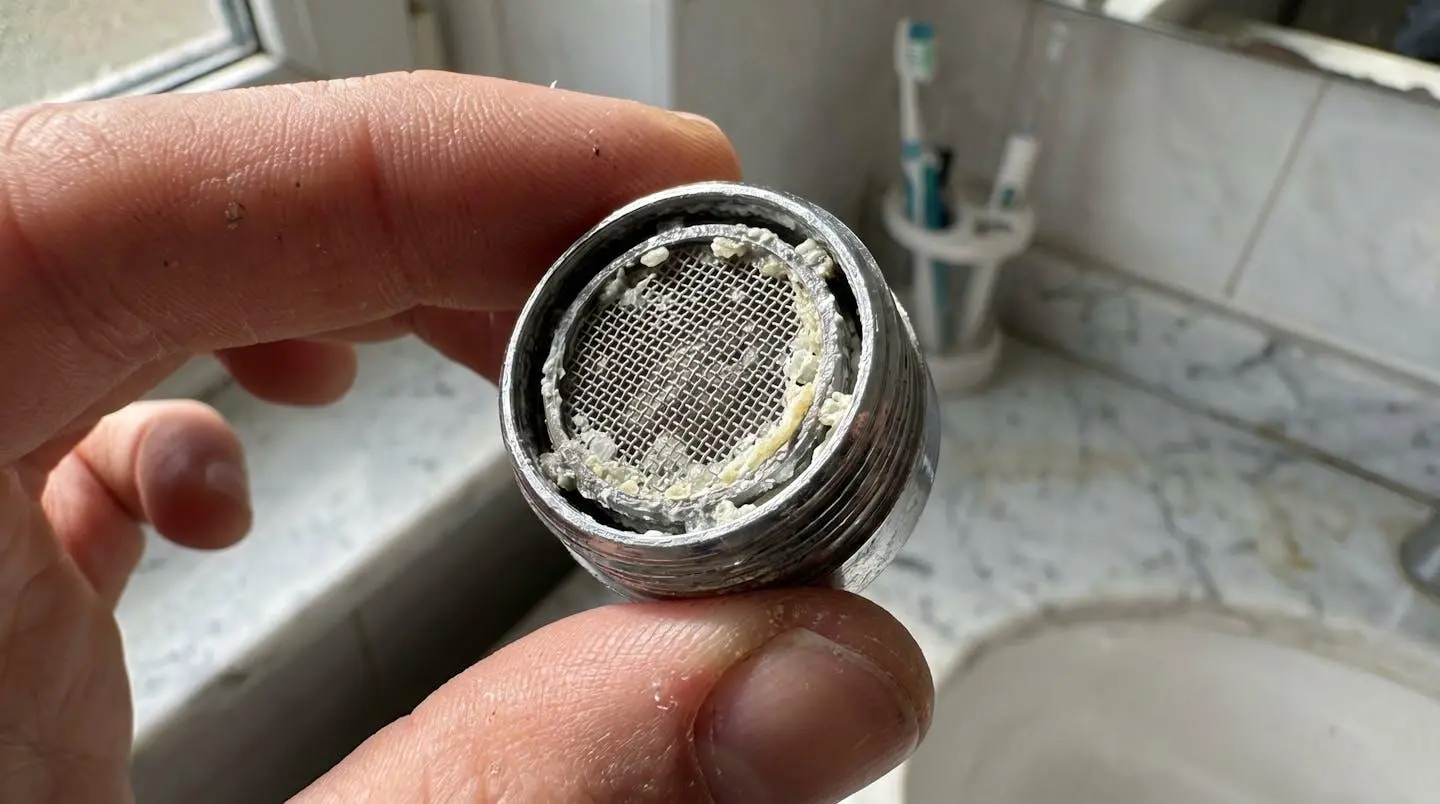
Most people assume weak flow equals low pressure. That assumption sends them hunting for problems in the municipal supply, the main valve, or hidden pipe damage. Meanwhile, the actual issue sits right at the spout—a tiny mesh screen called an aerator, quietly accumulating mineral deposits while you overthink the diagnosis.
An aerator screws onto your faucet’s tip and mixes air with water to create that smooth, splash-free stream. It’s a brilliant piece of engineering that also happens to be a magnet for calcium carbonate and other minerals commonly found in Ontario’s water supply. Over weeks and months, these deposits build up on the mesh, gradually strangling your flow without touching your pressure at all. Think of it like trying to breathe through a clogged air filter—the supply is fine, but the delivery mechanism is compromised.
This confusion between pressure and flow causes unnecessary service calls and wasted diagnostic time. When homeowners in the Guelph and Kitchener area experience reduced flow, professional plumbers serving Southwestern Ontario consistently find that aerator obstructions account for a significant portion of complaints. Fixing it requires nothing more than unscrewing the aerator, soaking it in vinegar, and screwing it back on.
Pressure vs Flow: Know the difference
Water pressure measures the force behind your supply, expressed in PSI (pounds per square inch). Ontario‘s drinking water system pressure guidelines confirm that normal operating pressure should range from 350 to 480 kPa, which translates to roughly 50 to 70 PSI. Flow rate, on the other hand, measures volume delivered per minute (GPM). You can have perfect pressure at 60 PSI yet experience terrible flow if your aerator is clogged. Pressure pushes, flow delivers—and most “pressure problems” are actually flow problems.
The regional context matters here more than most homeowners realize. Ontario’s Grand River watershed—which supplies Guelph, Kitchener, Waterloo, and Cambridge—delivers water with notably high mineral content. While municipal treatment ensures safety, it doesn’t strip out the calcium and magnesium that create what’s commonly called “hard water.” These minerals are harmless to drink but relentless on plumbing fixtures. They accumulate faster in this region than in softer-water areas, making aerator maintenance something you’ll encounter more frequently than, say, a homeowner in coastal regions.
Recent regulatory developments reinforce the importance of flow efficiency. As formalized in SOR/2025-110 published in the Canada Gazette, new faucet efficiency standards will apply to fixtures manufactured after July 2026, establishing maximum flow rate requirements measured at specified water pressures. Understanding the distinction between pressure (the force) and flow (the volume delivered) becomes even more critical as these standards take effect, since a clogged aerator can make a compliant fixture perform below its rated capacity.
Here’s the practical takeaway: before you start diagnosing complex pressure issues or calling for professional assessments, spend three minutes removing and inspecting your aerator. If you see white or yellowish buildup on the mesh, you’ve found your problem. Soak it in white vinegar for fifteen minutes, scrub it gently with an old toothbrush, rinse thoroughly, and reinstall. Test your flow. You’ll likely be shocked at the difference such a simple intervention makes.
Systematic diagnosis: Isolate the real problem in under 10 minutes
Effective troubleshooting starts with systematic observation, not wild guessing. You need to determine whether you’re dealing with a localized fixture issue or a house-wide supply problem. The distinction changes everything about your next steps, your timeline, and whether you can handle this yourself or need professional help.
This diagnostic sequence takes roughly ten minutes if you move deliberately through each test. Grab a notepad, test each scenario in order, and record what you observe. Start by testing every tap in your home—kitchen sink (hot and cold separately), bathroom sink, shower, bathtub, laundry hookup, outdoor hose connection if accessible. Turn each one fully open for ten seconds and compare the stream strength. If only one fixture shows reduced flow, you’ve immediately narrowed the problem to that specific tap or the supply line feeding it. This almost always points to aerator blockage, a partially closed fixture shut-off valve, or a kinked supply line under the sink.
For fixtures showing weak flow, isolate whether the problem affects hot water, cold water, or both supplies. Turn on only the cold tap fully, then only the hot tap fully. If only hot water flows weakly while cold runs normally, your issue lies with the water heater system—either a partially closed shut-off valve on the heater itself, sediment buildup in the tank restricting output, or a failing dip tube. If both hot and cold run weakly across multiple fixtures, you’re looking at a main supply problem affecting your entire household.
Locate your main water shut-off valve—typically found where the supply line enters your home, often in the basement near the front foundation wall or in a utility room. Examine the valve handle carefully. Ball valves should be fully parallel to the pipe (inline means open). Gate valves should be turned counterclockwise as far as they’ll go. It’s surprisingly common for main valves to be partially closed, especially after seasonal maintenance, recent repairs, or if someone unfamiliar with the system tried to adjust flow. Even a quarter-turn on a ball valve can dramatically reduce flow throughout your entire house. Residential plumbing standards specify that systems should maintain minimum pressure of 40 PSI even under flow conditions, but a partially closed valve creates artificial restriction that mimics low-pressure symptoms.
Review when the flow problem started. If reduction developed gradually over months, mineral buildup in aerators or pipes is likely—especially in homes with hard water or galvanized pipes. Clean aerators first, then consider professional pipe inspection if no improvement. If flow dropped suddenly overnight or within days, check for recently adjusted valves, kinked supply lines after recent work, or confirm municipal supply status by contacting your water utility. Sudden changes typically indicate mechanical issues rather than gradual accumulation, requiring same-day professional assessment if isolated to your property.
- Is the problem affecting one tap or all taps in your home?
One tap only: DIY fix highly likely (aerator obstruction or fixture valve issue). Remove aerator, clean thoroughly, check fixture shut-off valve position. Urgency: Low.
All taps: System-wide issue. Proceed to next question to isolate the cause.
- Does the problem affect hot water, cold water, or both?
Hot water only: Water heater system issue. Check heater shut-off valve position first, then inspect for sediment buildup. Urgency: Medium.
Both hot and cold: Main supply problem. Check main shut-off valve position immediately. If fully open and flow still weak, measure pressure with gauge. If below 40 PSI, contact licensed plumber. Urgency: High.
- Did the problem develop gradually over months or suddenly overnight?
Gradual decline: Likely mineral buildup in aerators or pipes. Start with aerator cleaning. If no improvement, consider professional pipe inspection for corrosion or scale accumulation (especially in homes built pre-1980 with galvanized pipes).
Sudden change: Valve position changed, supply line kinked, or acute municipal supply disruption. Check all accessible valves first. Contact municipality to confirm supply status. If isolated to your property, call professional plumber same day.

When mineral deposits become a structural threat
Not every flow problem resolves with a quick aerator cleaning. Sometimes the issue runs deeper—literally—inside your pipes themselves. Understanding when surface-level mineral buildup crosses into structural corrosion territory prevents small annoyances from becoming expensive emergencies.
Consider a common scenario in older Guelph properties built during the 1970s: a homeowner notices gradual flow reduction over six months, assumes it’s normal aging, cleans a few aerators occasionally, but never investigates further. What they don’t see is the progressive corrosion happening inside galvanized steel pipes that have been reacting with hard water for forty-plus years. These pipes develop internal rust and scale that narrows the effective diameter, choking flow while pressure readings stay technically acceptable.
Hard water minerals precipitate inside galvanized pipes, accelerating corrosion of the zinc coating and exposing steel underneath. The resulting rust combines with mineral deposits to create stubborn scale requiring professional intervention rather than simple cleaning. Copper and PEX pipes resist this corrosion far better, which is why construction codes shifted away from galvanized materials decades ago—but plenty of older Ontario homes still rely on original installations.
When limescale becomes a $2,000 problem
If your flow has dropped by more than half in less than six months, you’re past aerator-cleaning territory. This rapid decline typically indicates advanced pipe corrosion or severe internal buildup requiring professional assessment. Ignoring it risks complete blockage, burst pipes from pressure buildup, or emergency repairs when a critical line fails during winter. Professional inspection within two weeks prevents a minor issue from escalating into a major replacement project costing thousands rather than hundreds.
Timing your intervention correctly saves substantial money. Catching corrosion early—when flow reduction is noticeable but not yet critical—gives you time to plan replacement during off-peak seasons when plumbers have more flexibility and you can budget properly. Emergency calls during holiday weekends or mid-winter freezing conditions cost significantly more than scheduled work.
Consider two similar scenarios in the Southwestern Ontario region: according to regional plumber estimates, a homeowner in an older Guelph property experiencing gradual flow loss repeatedly cleaned aerators without investigating further, only to face emergency pipe replacement during a January cold snap costing approximately $2,800 including overtime rates. In contrast, a similar property owner scheduled professional pipe inspection at the first sign of multi-fixture flow reduction, discovered early-stage galvanized pipe corrosion, planned replacement during September off-season, and completed work for roughly $1,850—preventing a mid-winter emergency entirely. The difference in outcome came down to recognizing when surface-level maintenance wasn’t addressing the root cause.
For properties in the Southwestern Ontario region dealing with persistent hard-water issues, avoiding common plumbing installation errors during any renovation or repair work prevents compounding future problems with improper materials or configurations that accelerate mineral accumulation.
Your questions about tap flow issues in Ontario homes
Is Guelph and Kitchener water harder than other Ontario cities?
Yes, significantly. The Grand River watershed area supplying Guelph, Kitchener, Waterloo, and Cambridge delivers notably hard water compared to softer-water regions like Toronto or Ottawa, meaning accelerated limescale accumulation on fixtures and more frequent maintenance needs.
Can winter freezing cause gradual flow loss without pipes bursting?
Partially frozen pipes that haven’t completely blocked can reduce flow substantially without bursting. This occurs in poorly insulated exterior walls or unheated crawl spaces during extended cold snaps common in Ontario winters. Ice formation narrows the pipe’s interior diameter, restricting flow while the unfrozen portion maintains some delivery. If you notice flow reduction specifically during extreme cold that improves when temperatures moderate, insufficient insulation is likely contributing to the problem.
Should I replace galvanized pipes if my home was built in the 1970s?
If you’re experiencing frequent flow issues AND your home retains original galvanized pipes (check exposed sections in basement—they’re dull gray and magnetic), replacement deserves serious consideration. Galvanized steel corrodes internally after 40-50 years, especially with hard water. Planning replacement during your next major renovation prevents emergency situations and gives you control over timing and budget.
Will installing a water softener solve my flow problems?
A softener prevents future mineral buildup but won’t remove deposits already accumulated in your pipes or aerators. If your current flow is already compromised, you’ll need to clean or replace affected components first—remove and clean all aerators, descale visible fixtures, potentially flush supply lines professionally. After restoring proper flow, installing a softener prevents recurrence and dramatically reduces maintenance frequency. Think of it as fixing the damage first, then preventing it from happening again.
Why is faucet efficiency becoming a priority in Canada?
NRCan’s faucet efficiency framework specifies that new standards would reduce energy costs for Canadians by optimizing water heating demands. While flow problems like clogged aerators seem like minor inconveniences, they force water heaters to work harder for longer periods to deliver the same usable volume, increasing energy consumption. Maintaining proper flow through regular aerator cleaning and addressing mineral buildup contributes to both household efficiency and national energy reduction goals.
How much does professional flow diagnosis typically cost in Southwestern Ontario?
As of early 2026, licensed plumbers in the Guelph, Kitchener, and Waterloo area generally charge between eighty and one hundred fifty dollars for a diagnostic service call, which includes pressure testing, visual pipe inspection where accessible, fixture examination, and written assessment of findings. Many established companies offer transparent pricing and same-day availability. This upfront investment prevents guesswork and gives you a clear action plan with accurate cost estimates for any necessary repairs.
Preventive maintenance ultimately costs less than reactive emergency repairs. Regular aerator cleaning every three to four months in hard-water regions, annual inspection of visible pipe sections for early corrosion signs, and seasonal checks of shut-off valve positions catch problems while they’re still minor. For broader household system health, understanding timing for boiler maintenance and other major systems creates a comprehensive approach to avoiding sudden failures and maintaining comfortable, functional living spaces year-round.
- Remove aerators from your three most-used fixtures, soak in white vinegar for 15 minutes, scrub and reinstall
- Test flow at every tap in your home to map which fixtures are affected and which run normally
- Verify your main shut-off valve position (ball valves parallel to pipe, gate valves fully counterclockwise)
- If built pre-1980, inspect exposed basement pipes for galvanized steel (gray, magnetic) and note any visible corrosion
- Schedule professional inspection if flow dropped more than 50% in under six months or if all fixtures show weak flow despite cleaning
Flow problems rarely fix themselves. The mineral deposits accumulating right now in your aerators and pipes will only thicken with time, gradually worsening your delivery until what started as minor annoyance becomes disruptive inconvenience. Ten minutes of diagnostic work this weekend tells you whether you’re looking at simple maintenance or whether it’s time to bring in expertise before the problem escalates.